
Tennis Court Colors: How to Pick the Perfect Court Color Scheme

What Are the Best Tennis Court Colors?
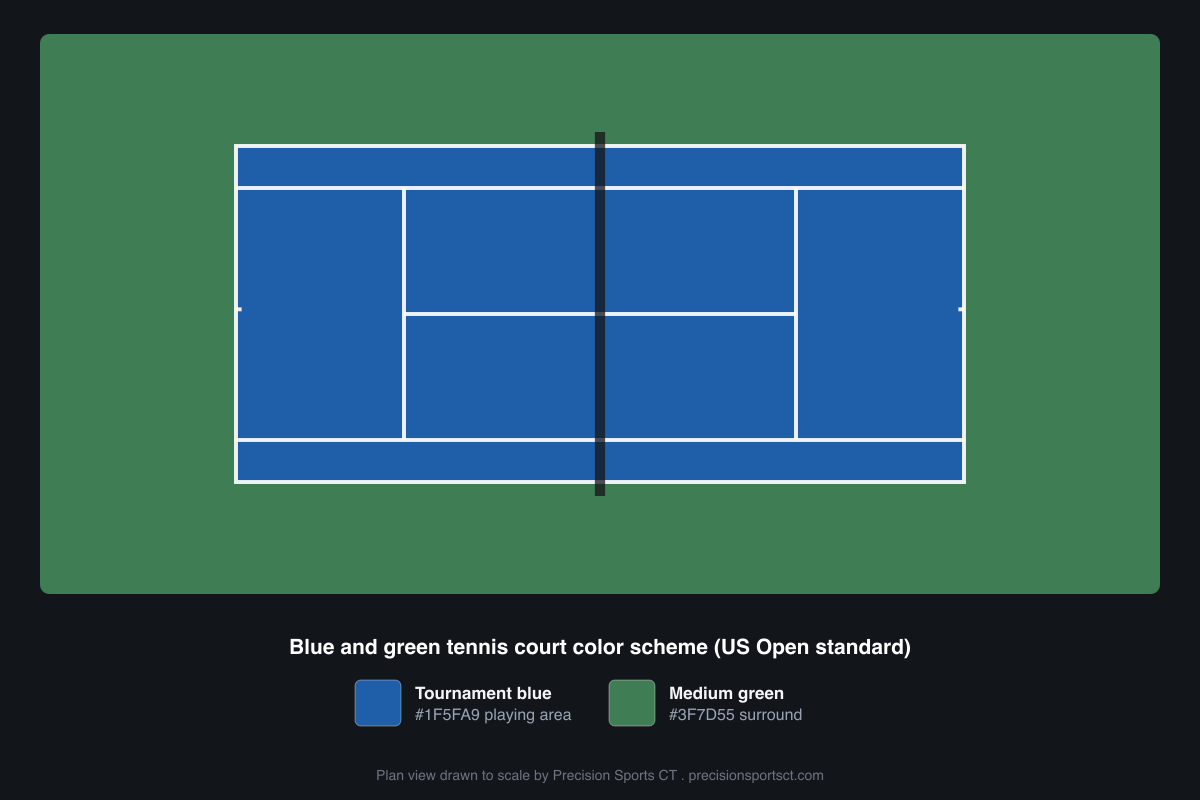
The most popular tennis court color scheme is a blue playing area inside a green outer zone, the same combination used at the US Open. Blue and green give the bright yellow tennis ball the strongest contrast, which helps players track it during fast rallies. Other common combinations include green on green, red inside green, and blue with gray. The best tennis court color for your court balances three things: ball visibility, heat absorption, and how well the surface hides wear and dirt over time.
Key Takeaways
- Most popular scheme: blue playing area with a green surround (US Open standard).
- Best for ball visibility: blue, because the yellow ball stands out most against it.
- Coolest surface: lighter shades like light green and gray absorb less heat.
- Best at hiding wear: green, which conceals dirt and scuffs in high-traffic settings.
- Color lifespan: 4 to 8 years before resurfacing refreshes the coating.
- Screen colors lie: textured acrylic reads darker outdoors than any hex code. Judge from a physical sample.
Tennis Court Color Combinations Compared
| Scheme | Color combination | Playing area | Surround | Best for |
|---|---|---|---|---|
| Blue and green | Medium or dark blue | Green | Tournament-style contrast, ball visibility | |
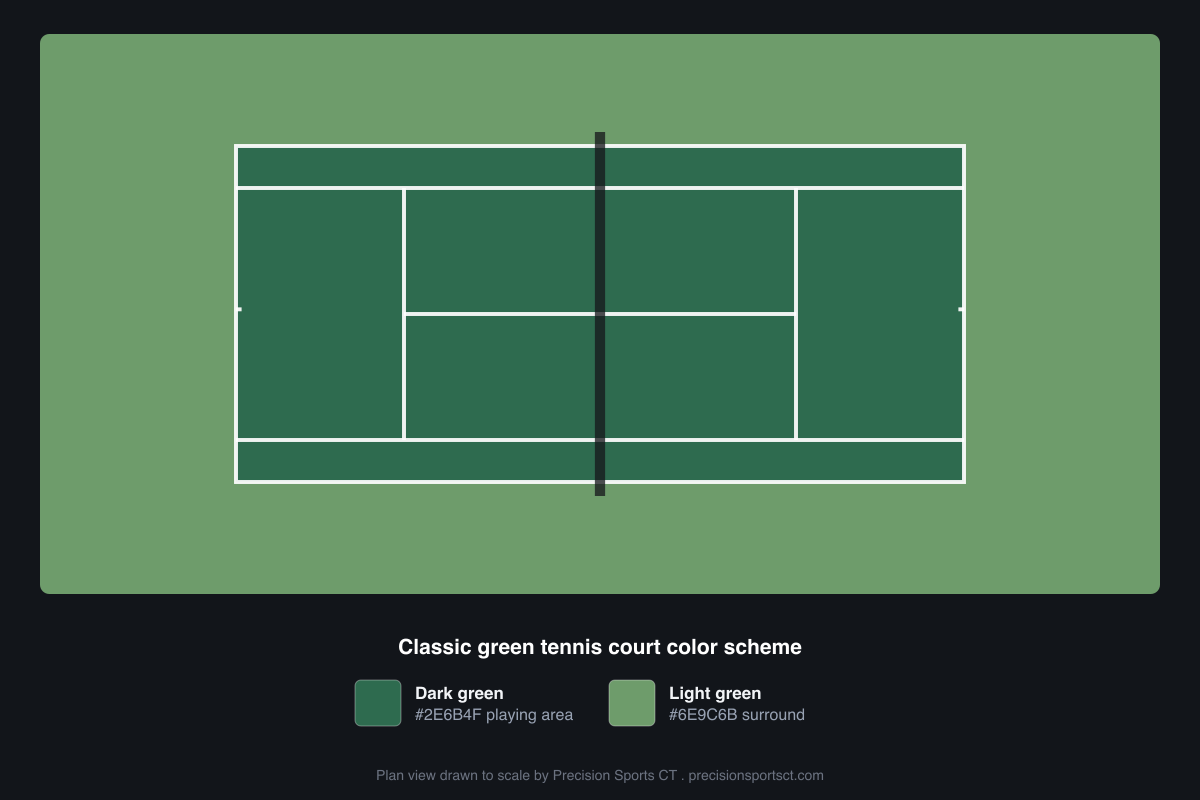
| Classic green | Dark green | Light green | Blending with landscaping, hiding wear | |
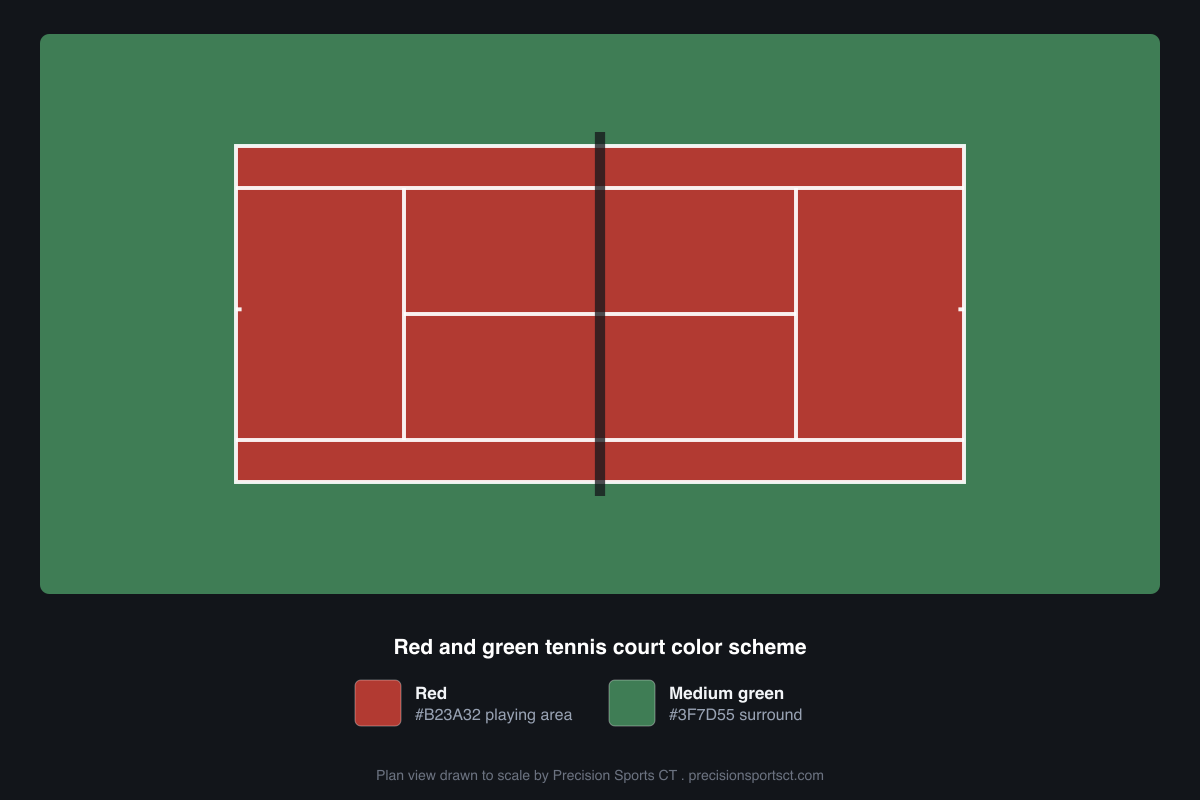
| Red and green | Red | Green | Clay-court look with hard-court durability | |
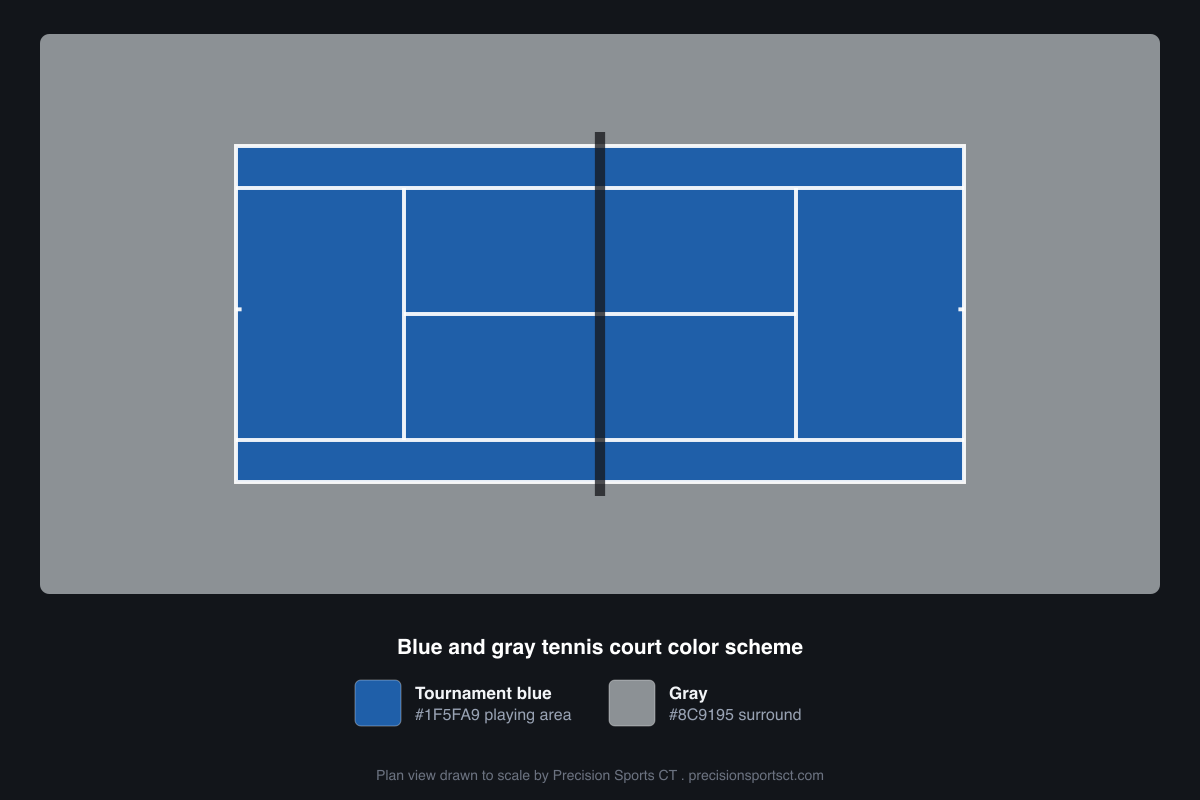
| Blue and gray | Blue | Gray | Modern aesthetics, reduced glare |
Each scheme in the first column is drawn in plan view: the outer band is the out-of-bounds surround, the inner rectangle is the playing area inside the lines, and the white line marks the net. Colors are the approximate screen equivalents from the palette below, not manufacturer specifications.
Every Tennis Court Color Scheme in Plan View
Each tennis court color scheme below is drawn to scale as a full court: 78 by 36 feet of doubles playing area on a 120 by 60 foot paved pad, with the singles sidelines, service boxes and net in place. Save or share any of them when you brief a builder, and read the hex codes as planning approximations rather than coating specifications.
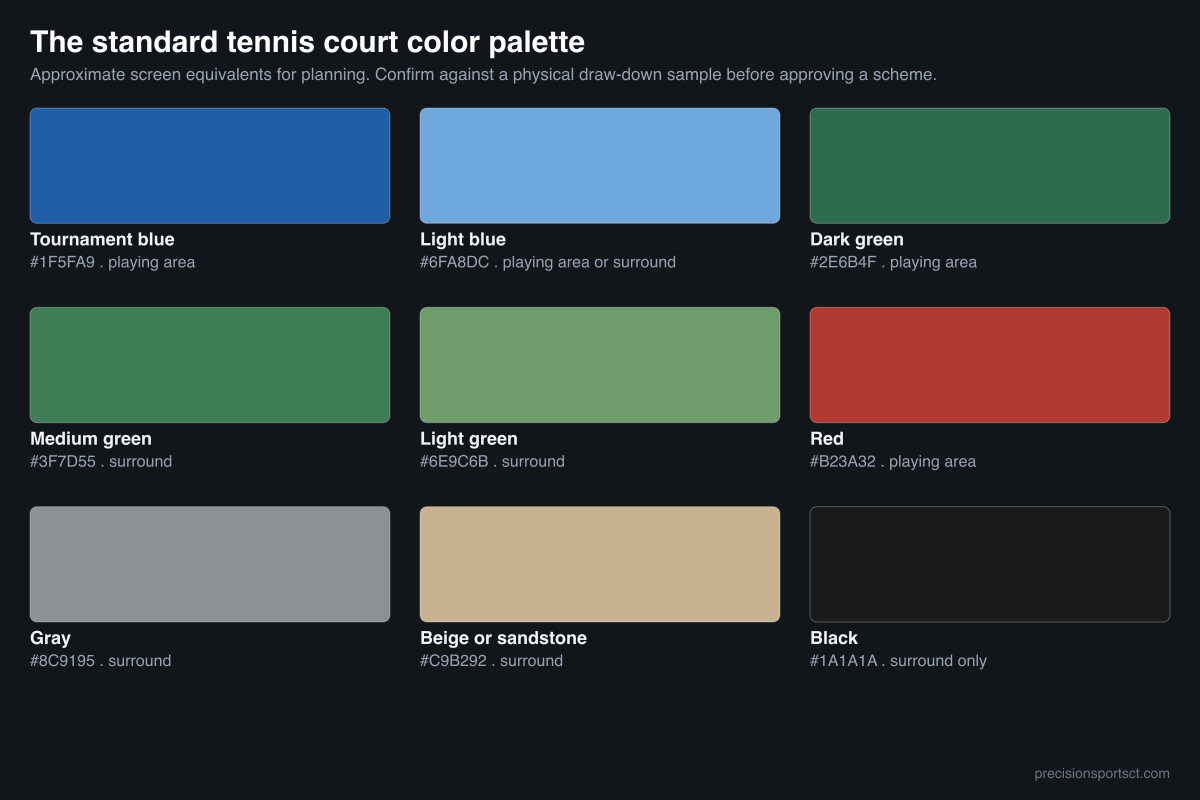
The Standard Tennis Court Color Palette
Acrylic court coatings are not mixed to order like house paint. Every major manufacturer of sport surfacing sells from a fixed palette of roughly ten standard colors, and almost every court in North America is built from that short list. Knowing the names is what lets you have a useful conversation with a builder, because the name on the contract is what gets ordered, not the picture you found online.
| Standard color | Typical role | Approximate screen equivalent | Notes |
|---|---|---|---|
| Tournament blue | Playing area | #1F5FA9 | The US Open look. Highest contrast with a yellow ball. |
| Light blue | Playing area or surround | #6FA8DC | Softer contrast, cooler underfoot than tournament blue. |
| Dark green | Playing area | #2E6B4F | The traditional American club court. |
| Medium green | Surround | #3F7D55 | Most common partner to a blue playing area. |
| Light green | Surround | #6E9C6B | Reflects more heat, most forgiving of dust and pollen. |
| Red | Playing area | #B23A32 | Clay-court appearance on a hard-court build. |
| Gray | Surround | #8C9195 | Modern, low glare, shows leaf stain and tire marks. |
| Beige or sandstone | Surround | #C9B292 | Popular in Florida for heat and for blending with hardscape. |
| Black | Surround only | #1A1A1A | Rare, and the hottest surface on this list. |
Color names are the common industry names used across acrylic sport-surfacing lines. The hex values above are approximations we use for planning mockups only. They are not manufacturer color specifications and should not be used to approve a scheme.
Why the hex code will not match your court
This is the single most common disappointment in court color selection, and it is worth understanding before you fall in love with a palette on a screen.
A screen emits light. A tennis court reflects it. Acrylic court coatings are also loaded with silica sand for traction and texture, and that texture scatters incoming light in every direction rather than bouncing it back cleanly. The practical result is that a finished court reads darker, flatter and slightly more muted than the same color viewed on a phone or monitor. A blue that looks vivid in a browser tab routinely lands closer to navy once it is on 7,200 square feet of textured acrylic in full sun.
Three habits prevent the disappointment:
- Ask for a physical draw-down sample of the exact coating and color, not a printed chart. The sample should be the real material on a textured card.
- Look at it outdoors, at the site, at the time of day the court gets the most use. Indoor lighting shifts every one of these colors.
- Look at it next to the surround color, not alone. Contrast between the two zones is what you are actually buying.
Why Tennis Court Color Matters More Than You Think
Court colors significantly impact player experience and performance. The predominant tennis ball color is bright yellow, so courts typically use darker shades like green or blue to create visual contrast. This contrast helps players track the ball quickly during rallies. Color selection also affects television appearance and how heat interacts with the playing surface.
Color also sets the constraints for everything applied afterward. Line paint has to contrast with whatever is beneath it, and if pickleball lines are ever added to the court, the second line color has to work against the first. If a shared court is anywhere in your future, read our sports court striping guide before locking the color scheme, not after. Basketball is the one sport that reverses the logic on this page, because the ball is orange rather than optic yellow, so the palette that works best for tennis is not the palette that works best there. The color rules for a basketball court cover that difference and which zone earns the color instead.
Standard Tennis Court Color Combinations
1. Blue and Green Courts
This represents one of the most popular combinations in the United States. The inner playing area is typically medium or dark blue, while the outer area is green, providing professional tournament-style appearance with strong ball visibility.
2. Classic Green Courts
A darker green playing area paired with a lighter green outer section offers a traditional appearance. These courts blend naturally with outdoor surroundings and hide dirt and wear effectively.
3. Red and Green Courts
Some facilities use red inner surfaces with green outer perimeters, resembling clay courts while maintaining hard court durability.
4. Blue and Gray Courts
This newer trend pairs blue playing areas with gray outer sections, offering modern aesthetics and reduced glare compared to lighter colors.
What Color Is a Tennis Court When It Is Wet?
A wet tennis court looks several shades darker than the same court dry. A blue playing area reads close to navy, a medium green surround reads nearly black-green, and the whole surface picks up a mirror-like sheen. This is not a defect and it is not the coating failing.
The reason is texture. A dry acrylic court is a rough, sand-filled surface that scatters light in all directions, which is what makes the color look bright and even. A film of rainwater fills that texture and turns a scattering surface into a reflecting one. Less light comes back to your eye as color, and more of it comes back as glare from the sky. Every hard court surface behaves this way; darker schemes just make the change more obvious.
Two practical consequences follow:
- Ball visibility collapses before the water does. The contrast you chose the color for is gone while the surface is still wet, and glare off standing water can be worse than the darkening. This is a real reason to stay off the court, separate from the slip hazard.
- A wet court is the best free inspection you will ever get. The way a court dries is the clearest diagnostic in the trade.
Reading a drying court: the nickel test
Watch the court after the rain stops rather than during it. A properly built court sheds water evenly and dries as one piece. Patches that stay dark after the surrounding surface has gone matte are holding water, and those are birdbaths: low spots in the base or the coating.
The field standard in court construction is simple. About an hour after the rain stops, look for any remaining puddle deep enough to submerge a US nickel, which is 1.95 mm (0.077 in.) thick. Anything that deep is out of tolerance and will keep getting worse, because standing water breaks down the coating faster than any other stress on an outdoor court. The American Sports Builders Association publishes the construction and flatness standards that court builders work to for exactly this reason.
| What you see after rain | What it means | What it needs |
|---|---|---|
| Whole court dark, dries evenly | Normal wet-surface darkening | Nothing, wait for it to dry |
| Isolated dark patches that persist | Birdbaths, low spots holding water | Patch leveling, usually with resurfacing |
| Dark line following a crack | Water entering the base through the crack | Crack repair before it undermines the slab |
| Blotchy, uneven drying across a whole panel | Uneven coating thickness or a bond failure | Surface assessment, possible resurfacing |
| Water pooling along one edge | Slope or drainage problem, not a color problem | Drainage correction |
If the drying pattern shows any of the bottom four, the court is telling you it needs work under the color, not a new color. See our tennis court repair guide for how to tell which fixes hold, and our guide to tennis court drainage solutions if the water is coming from the site rather than the surface.
One more point that gets missed: the surround color you pick changes how easily you can see all of this. Standing water is far more visible on a light green or beige surround than on gray or dark blue. Owners who want to monitor their own court are better served by a lighter surround.
Factors to Consider Before Choosing a Tennis Court Color
Visibility and Ball Tracking
High contrast between the ball and court surface improves reaction time. Blue and green combinations excel because the yellow ball stands out strongly against them.
Surrounding Environment
Court selection should consider the landscape. Courts located near trees, grass fields, or parks often use green tones because they blend naturally with outdoor environments.
Sunlight and Glare
Bright sunlight affects visibility on different surfaces. Darker colors reduce glare and enhance player comfort during midday matches.
Temperature and Heat Absorption
Darker colors absorb more heat, which can make the surface warmer during summer months. Lighter shades may help keep courts cooler in hot climates while balancing visibility needs. The ranking from coolest to hottest across the standard palette runs roughly: beige, light green, gray, light blue, medium green, tournament blue, red, dark green, black.
This matters far more in Florida than in Connecticut. On a South Florida court that sees midday play year round, a light surround is a comfort decision, not an aesthetic one. Most acrylic manufacturers also offer heat-reflective versions of their standard colors, which keep the same appearance while reflecting more of the infrared the surface would otherwise absorb. It is worth asking about on any Florida court build.
Maintenance and Wear
Some colors conceal scuffs and dust better than others. Green surfaces tend to conceal dirt more effectively than lighter shades, making them practical for high-traffic facilities. Gray and light blue show tire marks, leaf tannin stains and pollen most readily.
The Psychology of Tennis Court Colors
Color influences player psychology and court atmosphere. Blue courts are known to create a calm and focused atmosphere, while green courts convey a natural and traditional feeling. Red tones generate energy and intensity, though they are less common for hard courts.
How Professional Tennis Tournaments Choose Court Colors
Professional tournaments strategically select colors for both performance and television visibility. The US Open uses a bright blue playing surface with green outer areas providing excellent contrast for television viewers and players alike. The four Grand Slams are a useful reference precisely because they are not all the same: the US Open and the Australian Open are hard courts with blue playing areas, Roland Garros is red clay, and Wimbledon is grass. Only the first two are relevant to a hard-court color decision.
Custom Tennis Court Colors: Are They a Good Idea?
Popular custom options include navy blue, forest green, gray-blue combinations, and two-tone green courts. Custom choices work best when they maintain contrast between the playing area and surrounding surface.
Two cautions from experience. First, a color outside the standard palette can carry a longer lead time and a higher price, because it is a special order rather than stock. Second, and more important, a very dark or very unusual playing area is a decision you live with for the full 4 to 8 year coating cycle, and it is a decision the next owner of the property inherits.
Best Tennis Court Colors for Different Locations
Residential Backyard Courts
Homeowners often select colors matching landscaping or house design, with blue and green combinations remaining popular.
Schools and Universities
These facilities require durable colors that hide wear and maintain visibility. Green or blue courts with darker outer areas work well for these facilities.
Public Parks and Community Courts
Community courts benefit from colors that remain attractive despite heavy usage. Green courts are common in parks because they blend naturally with outdoor surroundings and hide dirt effectively.
Professional or Training Facilities
Competitive training facilities typically use blue playing areas with green or gray outer sections to replicate tournament conditions.
Tennis Court Resurfacing and Color Renewal
Over time, courts fade from sun exposure and heavy use. Resurfacing restores performance and refreshes color. During resurfacing, court owners have the opportunity to update the color scheme. Resurfacing includes crack repair, new acrylic layers, and line repainting.
Changing color at resurfacing is close to free, because the labor is already being paid for. Changing color between resurfacing cycles is not, because a color change on a sound court still means coating the whole surface. This is why a color decision is worth getting right at the start of a cycle. For what the work costs, see our tennis court resurfacing cost guide, or read about our tennis court resurfacing and repair service if your court is due for a color renewal. What the work actually involves depends on the surface system underneath the color, and a modular tile court is never coated at all, so check the renewal path for your surface in our guide to resurfacing a sport court by surface system before you plan a color change.
Working With Professional Tennis Court Builders
Experienced court builders understand how color affects playability, durability, and maintenance. They recommend shades that perform well under local weather conditions and apply high-quality acrylic coatings designed for sports surfaces. If you are planning a new court in Connecticut, see our guide to hiring tennis court builders in Connecticut for what to ask before you sign, or start with our tennis court construction service.
FAQs About Tennis Court Colors
What is the most popular tennis court color?
The most popular tennis court color scheme is a blue playing area surrounded by a green outer zone, the same combination used at the US Open. Blue and green give the bright yellow tennis ball the strongest contrast, which helps players track it during fast rallies. In the United States, blue-on-green is the default choice for both club and residential courts.
What are the standard tennis court color combinations?
The four standard tennis court color combinations are blue playing area with green surround, dark green on light green, red playing area with green surround, and blue with a gray surround. Blue and green is the tournament standard for contrast, all-green blends into landscaping and hides wear, red mimics clay, and blue-gray is a modern low-glare option.
What color tennis court is best for ball visibility?
A blue playing surface offers the best ball visibility because the yellow tennis ball stands out sharply against it. High contrast between the ball and the surface improves reaction time during rallies, which is why professional tournaments such as the US Open use blue courts for both players and television viewers.
What color is a tennis court when it is wet?
A wet tennis court reads several shades darker than the same court dry, because a film of water fills the surface texture and reflects light instead of scattering it. The color change is temporary and normal. What matters is how the court dries: patches that stay dark after the rest of the surface has dried are birdbaths, meaning low spots holding standing water, and they are a resurfacing issue rather than a color issue.
Do darker tennis court colors get hotter?
Yes. Darker tennis court colors such as dark blue and forest green absorb more sunlight and can make the surface noticeably warmer during summer play. Lighter shades like light green and gray reflect more heat and stay cooler, so hot-climate courts often favor lighter surrounds while keeping a darker playing area for contrast.
How long do tennis court colors last?
With proper maintenance, the acrylic color coatings on a tennis court typically last 4 to 8 years before they fade enough to warrant resurfacing. Sun exposure and heavy play wear the color over time. Resurfacing, which includes crack repair, new acrylic layers, and repainted lines, is the point at which many owners refresh or change the color scheme.
Can I pick a tennis court color from a hex code online?
No. Hex codes and on-screen palettes are useful for sketching a scheme, but they will not match the finished court. Acrylic court coatings are sand-filled and textured, so they scatter light and read darker and flatter outdoors than the same color does on a backlit screen. Always confirm the choice against a physical draw-down sample from the coating manufacturer before signing off.
Can you customize tennis court colors?
Yes, tennis courts can be customized with colors such as navy blue, forest green, gray-blue, and two-tone green courts. Custom colors work best when they keep strong contrast between the playing area and the surrounding surface so the ball stays easy to track.
What color are tennis court lines?
White, on almost every hard court. Line paint is a textured acrylic formulated for contrast and for grip, and white is the only color that holds strong contrast against every standard playing-area color on the palette. Where a second sport shares the court, the second set of lines is a contrasting color chosen so it does not compete with the primary lines. Our sports court striping guide covers line widths and blended-line layouts in detail.
Final Thoughts
The ideal color scheme balances appearance, visibility, and durability. Blue and green combinations remain most popular due to strong contrast and professional appearance, though other combinations work depending on location and preference. Pick from the standard palette, judge it from a physical sample outdoors, and make the decision at the start of a resurfacing cycle rather than the middle of one.
Precision Sports CT builds and resurfaces tennis courts across Connecticut and Florida. Request a quote or call +1 (203) 415-4532 to talk through a color scheme for your court.
Sources
- ITF Rules of Tennis, International Tennis Federation, for court dimensions and line specifications.
- American Sports Builders Association (ASBA), publisher of construction and surface tolerance standards for tennis courts.
- United States Tennis Association (USTA) facility guidance on hard court construction and maintenance.