
Basketball Court Colors: Standard Palette and Color Codes
What Are the Best Basketball Court Colors?
The best outdoor basketball court color scheme is a blue or medium gray playing area, a contrasting key, and a green or gray out-of-bounds surround. The reason is specific to basketball and does not apply to any other court sport: a regulation basketball is orange, so red, terracotta, and burnt orange court coatings produce the lowest ball contrast available, while blues and grays sit far enough away on the color spectrum to keep the ball readable. Basketball also inverts the color logic of tennis and pickleball. On those courts the playing area carries the contrast job. On a basketball court the ball spends most of its time in the air against the sky, so the zone that earns a distinct color is the key, which players read in peripheral vision while rebounding.
Key Takeaways
- Most reliable scheme: blue or medium gray playing area, contrasting key, green or gray surround.
- There is no official color code. Coatings are specified by manufacturer color name, not by hex. The palette below gives approximate screen equivalents and explains why a finished court never matches them.
- Indoor and outdoor courts are two different color systems. An arena court is painted maple. An outdoor court is a pigmented acrylic coating with no default color underneath.
- The one rule unique to basketball: the ball is orange, so red and orange-family surfaces are the weakest choice for ball visibility.
- Spend the color on the key. It is the only zone with a functional reason to differ from the playing area.
- Line color: white is standard. FIBA specifies 5 cm wide lines, about 2 inches, and mandates contrast rather than a specific color.
- Coating life: 4 to 8 years before fade and wear justify resurfacing.
- Planning a multi-sport court: go lighter. Dark basketball surfaces leave almost no readable line colors for pickleball or tennis added later.
Basketball Court Color Combinations Compared
| Scheme | Playing area | Key | Surround | Best for | Trade-off |
|---|---|---|---|---|---|
| Blue | Dark blue or navy | Green | Residential courts, strongest all-round ball contrast | Blue shows pollen and dust in spring | |
| Medium gray | Blue or black | Light gray | Modern look, low glare, multi-sport courts | Reads as industrial to some owners | |
| Light green | Dark green | Dark green | Backyard courts meant to disappear into landscaping | Lower ball contrast than blue or gray | |
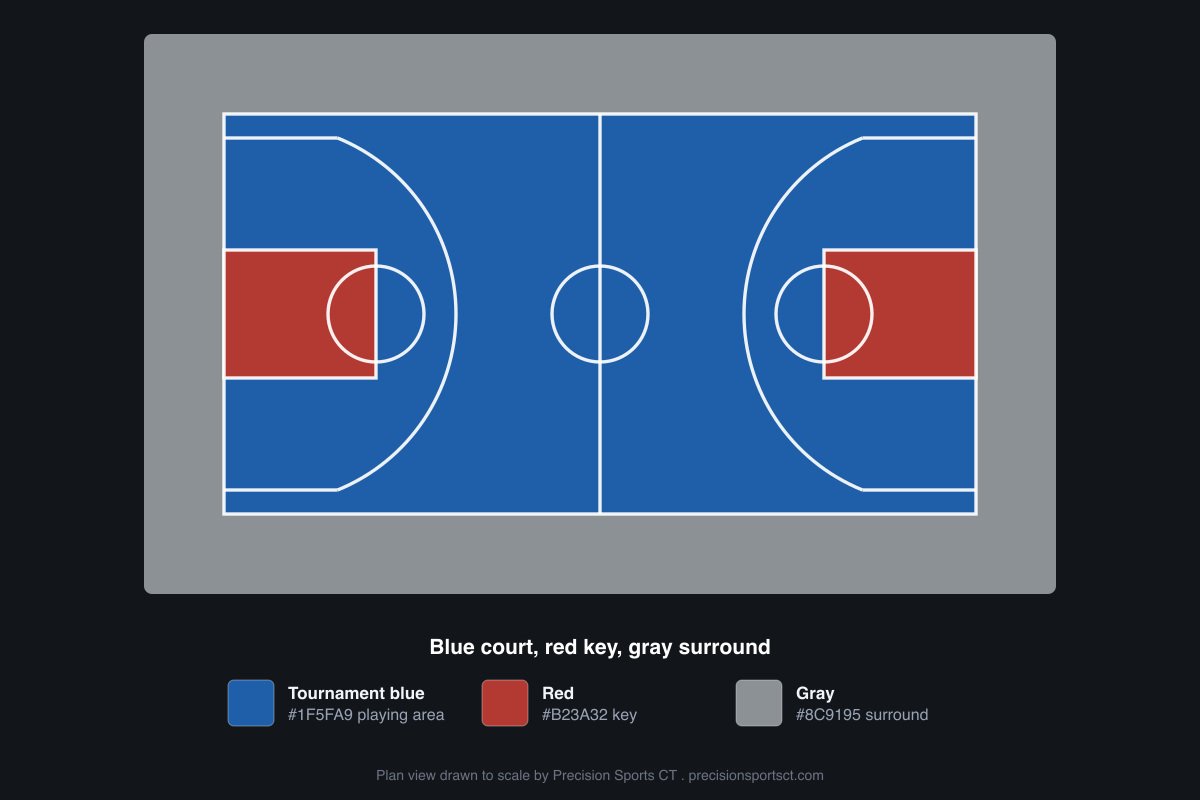
| Blue | Red | Gray | School and team identity without losing ball contrast | Red key needs crisp masking to look right | |
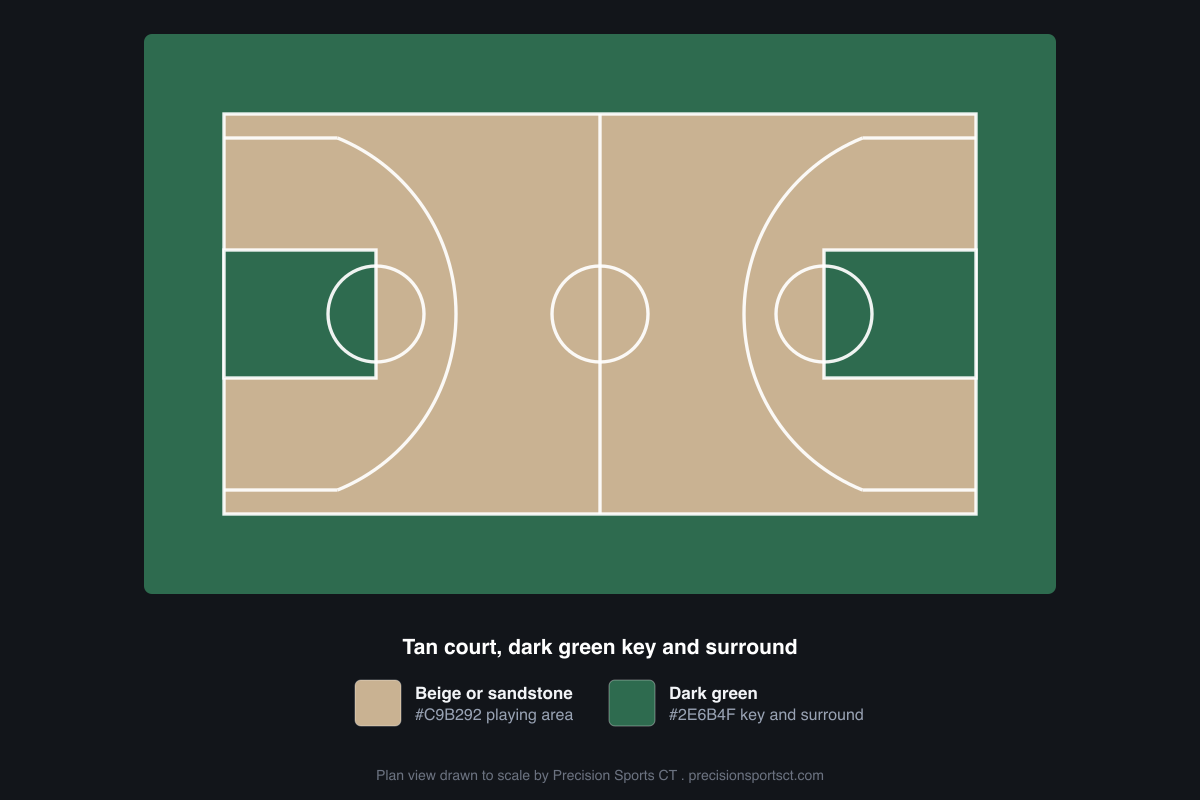
| Tan or sand | Dark green | Green | Hot climates, coolest surface underfoot | Shows tire marks and shoe scuffs fastest | |
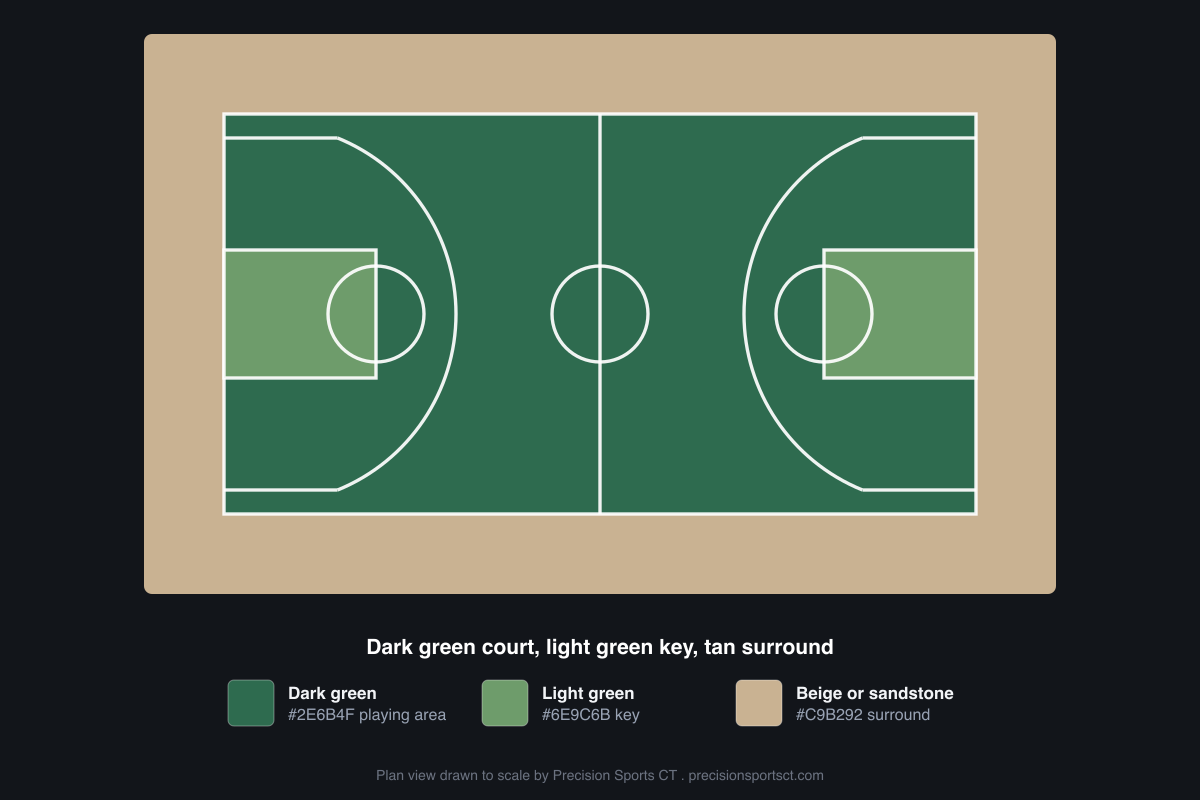
| Dark green | Light green | Tan | Courts under heavy tree cover where glare is low | Dark surface runs hot in open sun |
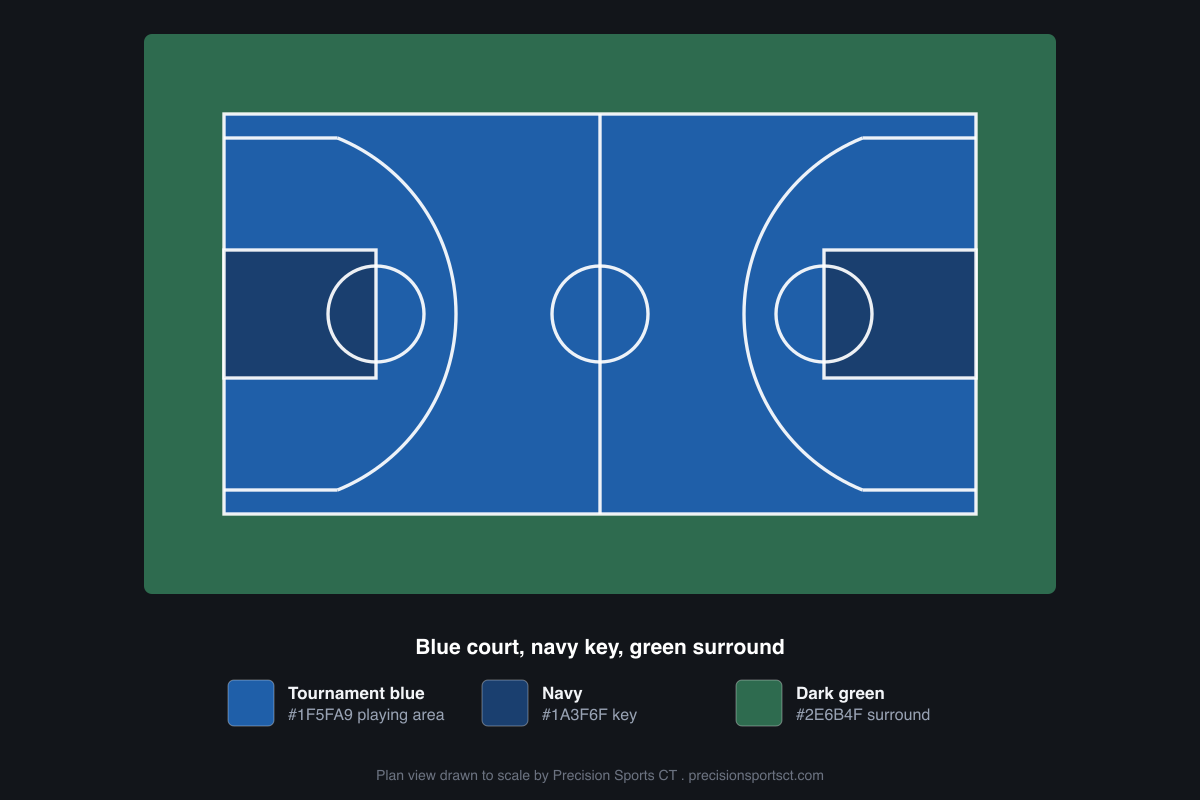
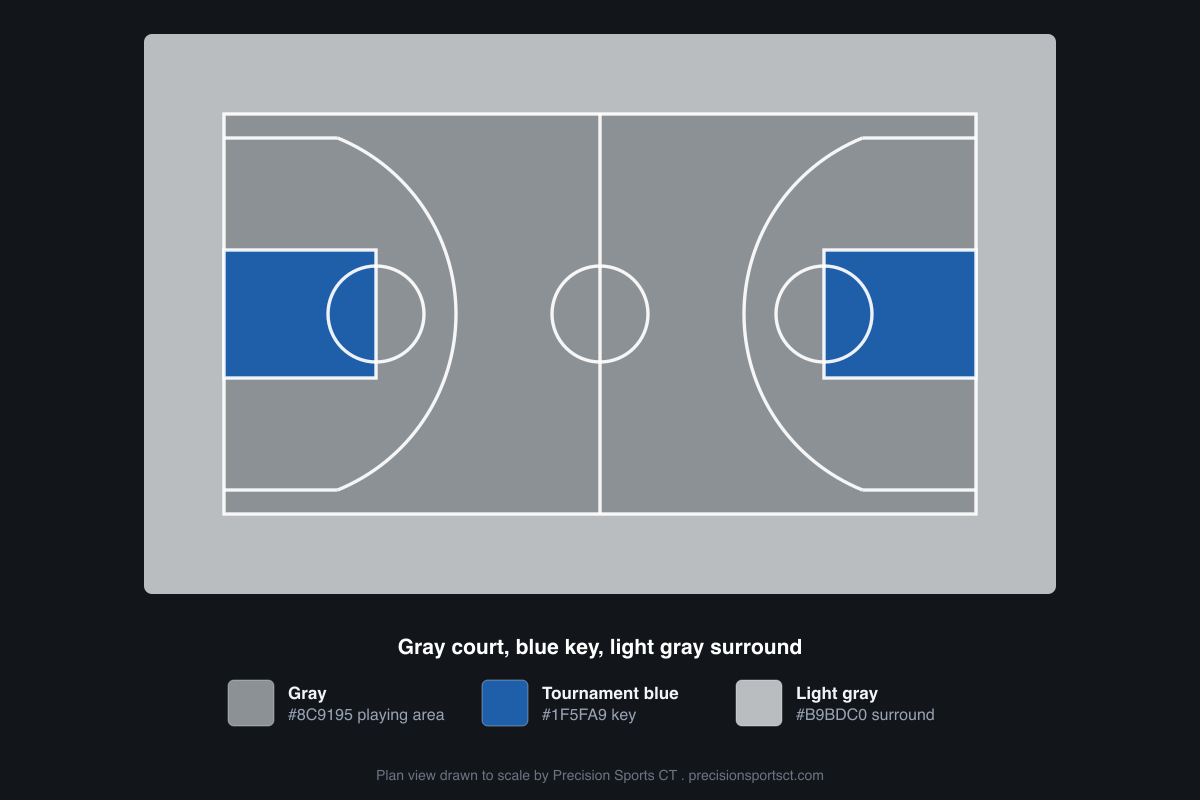
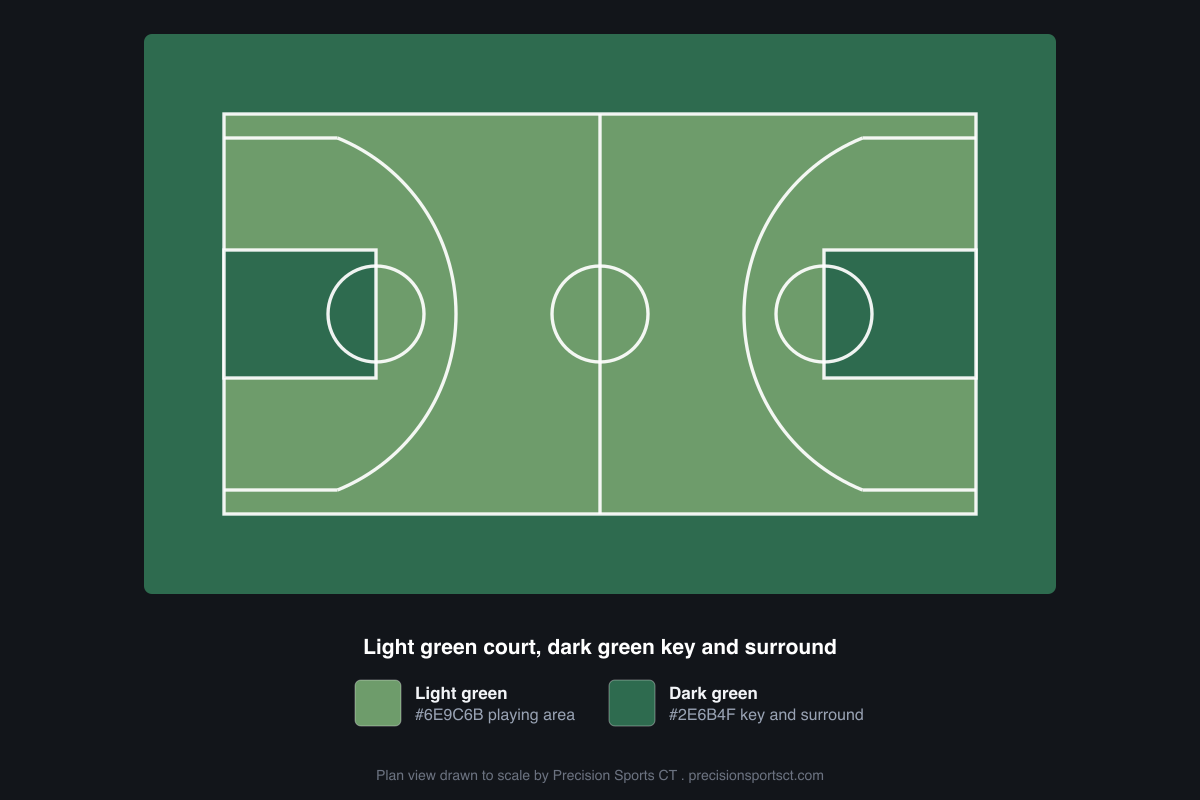
Each scheme in the first column is drawn in plan view: the outer band is the out-of-bounds surround, the inner rectangle is the playing area, and the two blocks are the keys. Colors are the approximate screen equivalents from the palette below, not manufacturer specifications.
Every Basketball Court Color Scheme in Plan View
Each basketball court color scheme below is drawn to scale as a full court: a 94 by 50 foot playing area on a 114 by 70 foot paved pad, with the keys, free-throw circles, three-point arcs and center circle in place. Save or share any of them when you brief a builder, and read the hex codes as planning approximations rather than coating specifications.
The Standard Basketball Court Color Palette
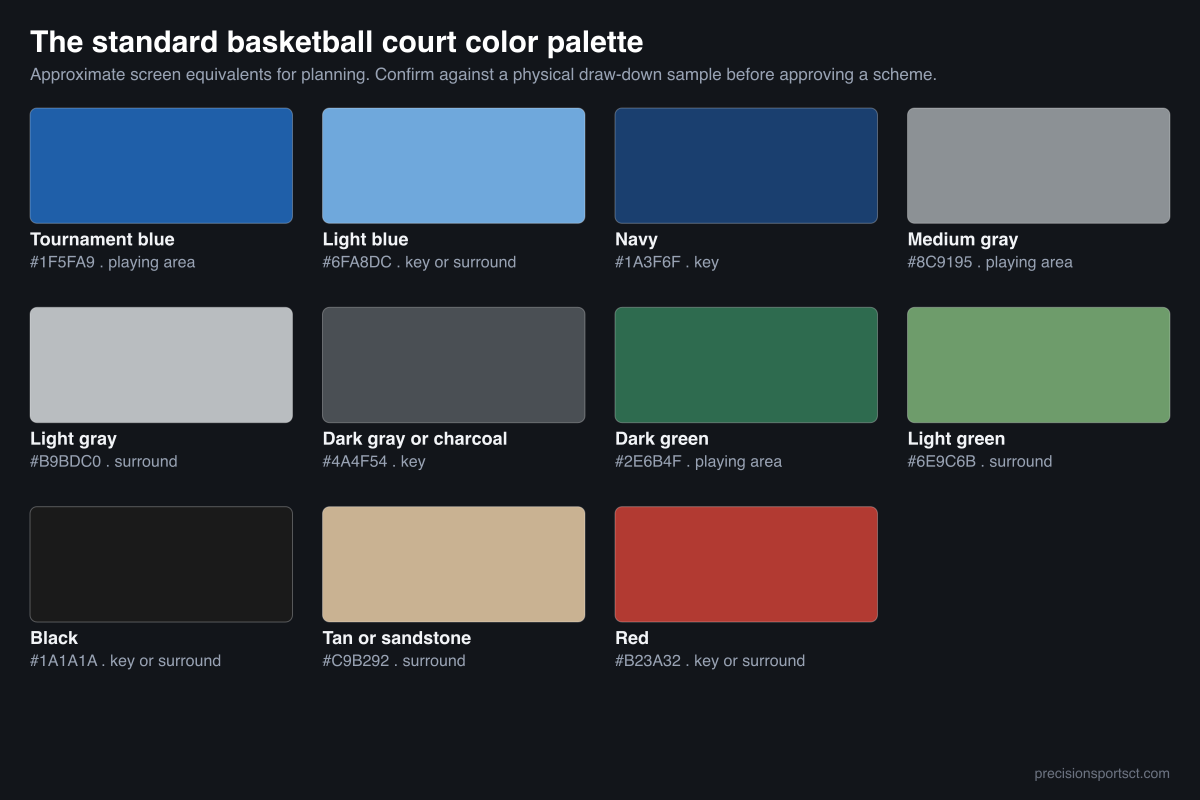
Most basketball court color guides show you photographs and leave you to guess what the colors are called. Here is the working palette, the role each color normally plays, and an approximate screen equivalent so you can visualize it before you see a physical sample.
The contrast column is the part that only matters for basketball. A regulation basketball is orange, which sits at roughly 20 degrees on the color wheel. The further a surface color sits from that point, the easier the ball is to read against the floor on bounce passes, loose balls, and rebounds off the rim. We have rated each color by that hue separation, plus how it behaves in practice on courts we have built and resurfaced.
| Standard color | Typical role | Approximate screen equivalent | Contrast with an orange ball | Notes |
|---|---|---|---|---|
| Tournament blue | Playing area | #1F5FA9 | Strongest | Roughly opposite orange on the color wheel. The default for a reason. |
| Light blue | Key or surround | #6FA8DC | Strong | Common key color inside a darker blue playing area. |
| Navy | Key | #1A3F6F | Strong | The darker relative of tournament blue, and the usual key inside a blue playing area. |
| Medium gray | Playing area | #8C9195 | Strong | Neutral, so it separates by lightness rather than hue. Lowest glare of the mid tones. |
| Light gray | Surround | #B9BDC0 | Moderate | Brightest neutral on the chart, the coolest gray underfoot, and the most forgiving surround for dust. |
| Dark gray or charcoal | Key | #4A4F54 | Strong | Reads as a filled block from across the court without looking heavy. |
| Dark green | Playing area | #2E6B4F | Strong | The traditional outdoor court. Hides pollen and dirt better than blue. |
| Light green | Surround | #6E9C6B | Moderate | The most forgiving surround for dust, leaf litter, and shoe scuff. |
| Black | Key or surround only | #1A1A1A | Strong | Highest ball contrast on the list and the hottest surface on it. |
| Tan or sandstone | Surround | #C9B292 | Weak | Coolest underfoot, popular in Florida, but too close to orange for live play. |
| Red | Key or surround | #B23A32 | Weakest | Sits beside orange on the wheel. Never the playing area. |
Why the hex code will not match your court
If you came here for a basketball court color code, take the values above as a starting point for a conversation, not as a specification. Three things break the match between a screen color and a finished court:
- The coating is sand filled. Acrylic court surfacing carries silica sand for texture and grip. That texture scatters light in every direction, so a finished court reads lighter, flatter, and less saturated than the same pigment on a screen or a paint chip.
- The key is a second coat over the playing area. Unlike a surround, which goes down on bare surface, a key is normally applied over the playing area color. What is underneath shifts what you see on top, and a light key over a dark playing area shifts most of all.
- Coatings are specified by manufacturer color name, not by hex. Sport surfacing manufacturers publish physical color charts and named colors rather than digital values, so there is no official hex code for any court coating to look up.
The only reliable method is the one every builder uses: order physical samples from the manufacturer’s chart and look at them outdoors, on the site, at the time of day the court will actually be played.
Outdoor Basketball Court Colors: The Four Schemes That Get Specified
Across residential, school, and municipal outdoor courts, the vast majority of what gets built comes from a much shorter list than the palette above suggests. In our experience the recurring specifications are:
- Blue playing area, dark blue or gray key, green surround. The most requested residential scheme.
- Medium gray playing area, blue key, light gray surround. The modern look, and the most multi-sport friendly.
- Dark green playing area, light green key, green surround. The court meant to disappear into landscaping.
- Blue playing area, red key, gray surround. Team identity without putting red under live play.
Everything else is a variation on those four. If you are choosing from a chip card and feeling overwhelmed, start by picking which of these four you are actually building.
The Orange Ball Problem
This is the single fact that separates basketball court color from tennis court colors and pickleball court colors, and it is missing from most color guides.
A tennis ball is optic yellow. A pickleball is optic yellow, neon green, orange, or white. Neither yellow nor neon green is ever a serious candidate for a court surface color, so tennis and pickleball color guides never have to solve a ball-versus-floor conflict. They only have to solve ball-versus-sky and line-versus-floor.
Basketball is different. A regulation basketball is orange, and orange sits directly beside red and terracotta, which are two of the most requested court colors in the residential and school markets because they carry team identity. An orange ball on a red court is the lowest-contrast pairing available in court sports.
This matters less than people expect on shots, because a shot is tracked against the sky or a backdrop. It matters a great deal on bounce passes, loose balls, and rebounds off the rim that hit the deck, where the ball is being read against the surface itself.
The practical resolution is not to ban red. It is to move red off the playing area:
| If the client wants red | Put it here | Why it works |
|---|---|---|
| Team or school identity | The key | Small area, high visual impact, ball is rarely tracked against the floor there |
| A bold, warm-looking court | The surround | Largest visible area, and the ball is out of play when it is over the surround |
| Red everywhere | Not recommended | Removes floor contrast across the entire live playing area |
Basketball Color Zones Work Backwards From Tennis and Pickleball
On a tennis court the color decision is playing area versus surround. On a pickleball court it is three zones, because the non-volley zone needs its own shade. A basketball court has a different set of zones again, and the ranking of which one deserves the color budget is reversed.
| Zone | Typical size | What the color does |
|---|---|---|
| Key, also called the lane or the paint | 16 ft wide in the NBA, 12 ft in NCAA and high school | The one zone with a real functional job. Players read the lane edge in peripheral vision while boxing out and rebounding |
| Playing area inside the boundary lines | 94 ft by 50 ft in the NBA, 84 ft by 50 ft in NCAA and high school | Carries floor contrast for the ball on bounces and loose balls |
| Out-of-bounds surround | Everything from the boundary line to the fence | The largest painted area, so it drives heat, glare, and how dirty the court looks |
The reason the key earns the color is that basketball has a rule enforced on that exact boundary. The three-second violation depends on whether a player is standing inside the lane, and players judge that without looking down. A key that reads instantly in peripheral vision is a playability feature, not decoration. On a court with a single flat color and only painted lines, players lose the lane edge in low light far sooner than on a court where the key is a filled block of contrasting color.
For the full geometry these zones sit on, see the basketball court dimensions guide.
What Color Is a Basketball Court? Indoor Maple vs Outdoor Acrylic
This question gets one answer online and it is only ever half of the answer, because there are two completely different basketball court color systems and almost nothing transfers between them.
| Indoor competition court | Outdoor court | |
|---|---|---|
| Surface | Hard maple strip flooring | Acrylic coating system over asphalt or concrete |
| Where the color lives | Stain and finish on the wood, plus paint in specific zones | Pigmented coating across the entire surface |
| Default appearance | Natural blonde wood tone | Whatever color was specified |
| Zones that get color | Key, center circle, sometimes the area outside the sidelines | Playing area, key, and surround |
| Changing the color | Sand and refinish the floor | Resurface with new acrylic coatings |
An NBA or NCAA court is a wood floor, so its base color is the color of maple. The color you notice on television is paint applied to specific zones of that floor: the key, the center circle, the team logos, and on many courts the border outside the sidelines. That is why arena courts have looked increasingly colorful over the years while the playing surface itself has not changed material. Teams are painting more zones of the same wood floor, not laying a colored surface.
An outdoor court has no equivalent of the wood. There is no default color underneath, because asphalt and concrete are structural and get covered. Every square foot is a color decision, which is exactly why the surround matters so much outdoors and barely exists as a concept indoors.
The practical consequence is worth stating plainly, because it is where homeowners lose time: if you are planning a backyard or driveway court and you gathered your color inspiration from photographs of arena floors, very little of it is buildable. Wood tone has no acrylic equivalent, the lighting is controlled indoors and is not outdoors, and heat and glare do not apply to an air conditioned arena. Start from the outdoor palette above instead.
Line Color and Width: What the Rules Actually Say
FIBA, the international governing body for basketball, specifies court lines 5 centimeters wide, which is approximately 2 inches. NBA and NCAA courts also use 2 inch lines. What no governing body specifies is a line color. The rules require that lines be a single color and clearly visible, which makes the real requirement contrast with the surface underneath.
In practice:
- White is the default on blue, green, gray, and tan acrylic courts, and it is what most residential and school courts use.
- Black or dark blue lines are occasionally used on very light tan or light gray courts where white would wash out in direct sun.
- Yellow lines appear on some outdoor courts, but yellow against an orange ball reduces the visual separation between the ball and the markings, so it is a weaker choice for basketball than it is for tennis.
If the court will ever carry a second sport, the line color decision stops being cosmetic. See the multi-sport section below.
School Colors, Team Identity, and What It Costs to Change
Color is one of the few court decisions that is genuinely expensive to reverse. Changing a scheme means resurfacing, which is not a repaint but a full acrylic recoat and restripe. Whether your court can accept a recoat at all depends on what is underneath the color, which is set out surface by surface in our guide to sport court resurfacing.
That makes team-color requests worth planning rather than refusing. A school or a family that wants its colors on the court can have them, and the least destructive way to deliver that is:
- Key in the primary team color. High impact, small area, no loss of live-play floor contrast.
- Surround in the secondary color. Large visible area, zero impact on ball tracking.
- Playing area in blue or gray. The neutral that keeps the ball readable and keeps the court resellable if the property changes hands.
The third point matters on residential projects. A court painted in one family’s school colors is a feature for them and a resurfacing cost for the next owner. Blue and gray playing areas are the closest thing to a neutral in this category.
What We Used on a Connecticut Multi-Sport Court
On our Personal Residence project in Connecticut, a private multi-sport court built for both basketball and pickleball, we finished the surface in a blue and yellow scheme with premium acrylic coatings rated for all-weather performance.
That combination was chosen because the court had to serve two sports with different balls. Blue holds contrast against an orange basketball and against a yellow or neon green pickleball, which is the harder of the two jobs, and the yellow zone gave the court a visual identity without putting a warm color under live basketball play. A red or terracotta scheme would have compromised both sports at once.
Our Home Court project, a residential full cushion system installation in Connecticut, is the other pattern we see often: a cushioned basketball surface where the color scheme sits on top of a shock-absorbing system, so the coating choice has to be compatible with the cushion layer rather than chosen from a paint chip alone.
Multi-Sport Courts: Basketball Color Constrains Everything Added Later
Basketball is the most commonly overlaid court surface in residential construction. Owners add pickleball lines, sometimes tennis, occasionally both. The basketball color decision made on day one determines how well those additions can be read years later, and this is where most regretted color choices actually come from.
Each sport added to a court needs its own line color that contrasts with the surface and with the other sports’ lines. A dark navy or dark green basketball surface leaves very few colors that read clearly: white is taken by basketball, and the remaining options are pale and low-contrast against a dark background.
| Basketball surface | Lines available for a second sport | Result |
|---|---|---|
| Light gray or tan | White, black, blue, red, green | Wide latitude, easy to keep sports visually separate |
| Medium blue | White, yellow, light gray | Workable, the usual compromise |
| Dark navy or dark green | White and very light tints only | Second sport’s lines compete with basketball’s |
If a multi-sport court is even a possibility, choose a lighter or mid-tone basketball surface now. It costs nothing at the time and preserves every option later. For layout planning, see the multi-sport combination court guide, and for what line work costs, the sports court striping guide.
Heat, Glare, and How Long Basketball Court Color Lasts
Dark acrylic coatings absorb more sunlight and run warmer than light ones. On a basketball court the surround is usually the largest single painted area, so the standard way to control surface temperature without giving up ball contrast is to keep the playing area darker and the surround lighter. Tan, sand, and light gray surrounds run coolest.
Glare works in the opposite direction. Very light surfaces in open sun throw more reflected light back at players, which is why fully white or near-white playing areas are not used outdoors. Medium tones in blue, gray, and green are the range that balances both.
Acrylic color coatings on an outdoor basketball court typically hold their color for 4 to 8 years before fading and wear justify resurfacing. Full sun and daily play push a court toward the short end. Because a color change requires a resurfacing anyway, resurfacing is the natural moment to revisit a scheme rather than a reason to postpone one. Our basketball court resurfacing service covers recoating and restriping together, and the basketball court resurfacing guide for Connecticut covers timing and cost.
FAQs About Basketball Court Colors
What is the color code for a basketball court?
There is no official hex or RGB code for a basketball court, because sport surfacing manufacturers publish physical color charts with named colors rather than digital values. As approximate screen equivalents, tournament blue is near #1F5FA9, medium gray near #8C9195, and dark green near #2E6B4F. A finished court reads lighter and flatter than any of those values because acrylic court coatings are filled with silica sand, which scatters light. Order physical samples and view them outdoors before committing.
What color is a basketball court?
It depends on whether the court is indoor or outdoor, and the two answers share almost nothing. An indoor competition court is hard maple, so its base color is natural wood tone with paint applied to the key, the center circle, and often the border outside the sidelines. An outdoor court is an acrylic coating system over asphalt or concrete with no default color underneath, so every zone including the out-of-bounds surround is a deliberate color choice.
What are the best outdoor basketball court colors?
Four schemes account for most outdoor courts that get built: blue playing area with a dark blue or gray key and a green surround, medium gray playing area with a blue key and light gray surround, dark green playing area with a light green key and green surround, and blue playing area with a red key and gray surround. All four keep a warm color off the live playing area, which is what preserves contrast against an orange ball.
What are the best basketball court colors?
The most reliable outdoor basketball court scheme is a blue or medium gray playing area with a contrasting key and a green or gray out-of-bounds surround. Blue and gray both sit far from the orange of a basketball on the color wheel, so the ball stays readable in the air and against the floor. Green and gray surrounds hide dirt and shoe marks across the largest painted area of the court.
Why are red basketball courts a bad idea?
A regulation basketball is orange, and red, terracotta, and burnt orange court coatings sit in the same part of the color spectrum. That is the lowest contrast pairing available in court sports, and it makes the ball harder to pick up against the floor on bounce passes and loose balls. Red is still one of the most requested colors because it carries school and team identity, so the usual compromise is a red key or red surround with a neutral playing area.
What color should the key be on a basketball court?
The key, also called the lane or the paint, is the one zone on a basketball court with a genuine functional reason to be a different color. It should contrast clearly with the playing area so players read the lane boundary in peripheral vision during rebounding and three-second calls. A darker or fully saturated key inside a lighter playing area is the most common treatment on residential and school courts.
What color are basketball court lines?
White is the standard line color on outdoor acrylic basketball courts. FIBA specifies lines 5 centimeters wide, which is about 2 inches, and NBA and NCAA courts use 2 inch lines. No governing body mandates a specific line color, only that lines are a single color and clearly visible, so the requirement in practice is contrast with whatever surface color sits underneath.
Do dark basketball courts get hotter?
Yes. Dark blue, black, and forest green acrylic coatings absorb more sunlight and run measurably warmer than light gray, tan, or light green. On a basketball court the surround is usually the largest painted area, so keeping the surround light while the playing area stays dark is the normal way to hold contrast without turning the whole slab into a heat sink.
How long do basketball court colors last?
Acrylic color coatings on an outdoor basketball court typically hold their color for 4 to 8 years before fading and wear justify resurfacing. Courts in full sun and heavy daily use sit at the short end of that range. Resurfacing is the natural point to change a color scheme, because new coatings and fresh lines go down together.
What colors should a multi-sport basketball court be?
On a court that will also carry pickleball or tennis lines, choose a lighter or mid-tone basketball surface. Every sport added later needs its own line color that contrasts with the surface, and a dark court leaves very few usable line colors. Picking a dark scheme for basketball alone is the most common reason a multi-sport conversion later looks cluttered.
Can you change the color of an existing basketball court?
Yes, but it is a resurfacing job rather than a repaint. The existing surface is cleaned and repaired, new acrylic color coats are applied, and the lines are restriped on top. Because the labor is the same whether the color changes or not, a resurfacing already scheduled is the cheapest moment to change a scheme.
Choosing a Scheme With Your Court Builder
Bring three things to the conversation: whether the court will ever carry a second sport, whether anyone involved wants team or school colors, and how much direct sun the site gets. Those three answers narrow the scheme faster than a color chart does, because they decide the surround tone, where identity colors can safely go, and how dark the playing area can be.
Precision Sports CT is a member of the American Sports Builders Association and builds and resurfaces basketball courts across Connecticut and Florida. See our basketball court installation service, our basketball resurfacing and lines service, or the Connecticut court builder hub for service areas.
Related Reading
- Tennis Court Colors: How to Pick the Perfect Court Color Scheme
- Pickleball Court Colors: Best Combinations for Ball Visibility and Play
- How Many Square Feet Is a Basketball Court? Size and Dimensions
- Multi-Sport Combination Court Guide
- Sports Court Striping: Line Widths, Blended Lines, and Restriping Costs
Sources
- FIBA Official Basketball Rules, International Basketball Federation, for line width and court marking specifications.
- NBA Official Rules and NCAA Men’s and Women’s Basketball Rules, for lane and court dimensions.
- American Sports Builders Association (ASBA), publisher of construction and surfacing standards for outdoor sport courts.
- Maple Flooring Manufacturers Association (MFMA), for hard maple as the standard indoor competition basketball floor.