
Pickleball Court Colors: Best Combinations for Ball Visibility and Play

What Are the Best Pickleball Court Colors?
The best pickleball court color scheme is a blue playing area surrounded by a green out-of-bounds zone, with the non-volley zone painted a third, contrasting shade. Blue gives a yellow or neon green ball the strongest contrast, the green surround hides dirt and wear across the largest area of the court, and a separate kitchen color makes the non-volley line readable at speed. Unlike tennis, pickleball courts are usually painted in three zones rather than two, and the ball is not always the same color, so the right scheme depends on which ball your players use and whether the court is indoors or outdoors.
Key Takeaways
- Most common scheme: blue playing area, green surround, lighter blue kitchen.
- Best for ball visibility: blue or medium gray, which contrast strongly with yellow and neon green balls.
- Line color: 2 inch wide lines in one color that clearly contrasts with the surface, per USA Pickleball. White is the default.
- Three zones, not two: playing area, non-volley zone, and out-of-bounds surround are each a color decision.
- Coating life: 4 to 8 years before fade and wear justify resurfacing.
- Heat: dark coatings run hotter, which matters most on the large surround area.
Pickleball Court Color Combinations Compared
| Scheme | Playing area | Kitchen | Surround | Best for | Trade-off |
|---|---|---|---|---|---|
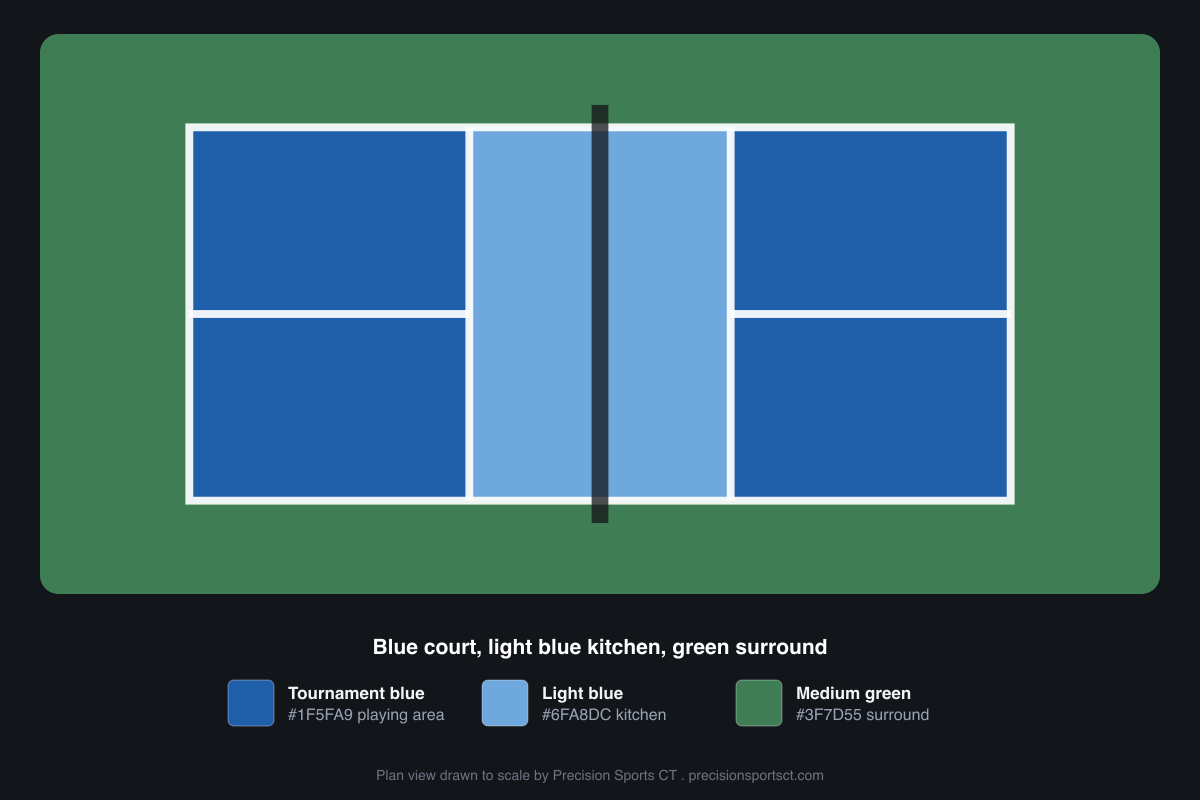
| Blue | Light blue | Green | Tournament play, yellow and neon green balls | Shows dust and pollen on the blue | |
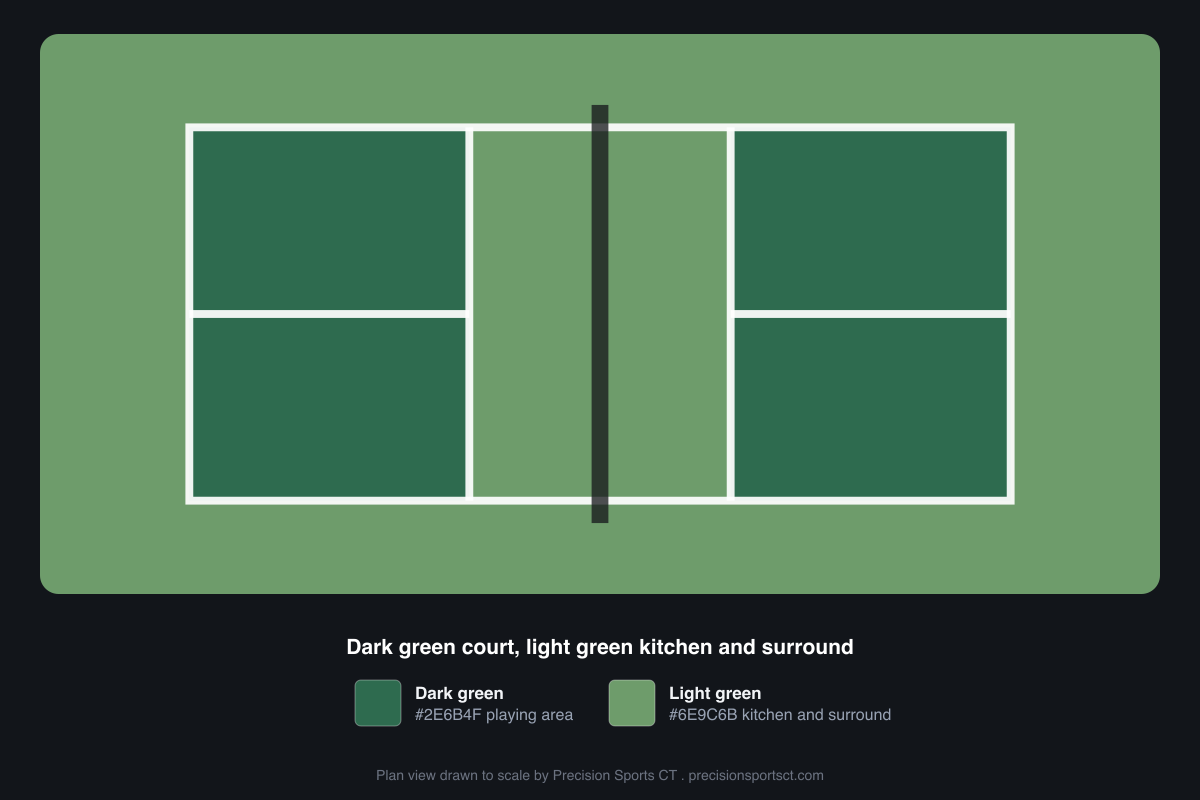
| Dark green | Light green | Light green | Backyard courts that blend into landscaping | Lower ball contrast than blue | |
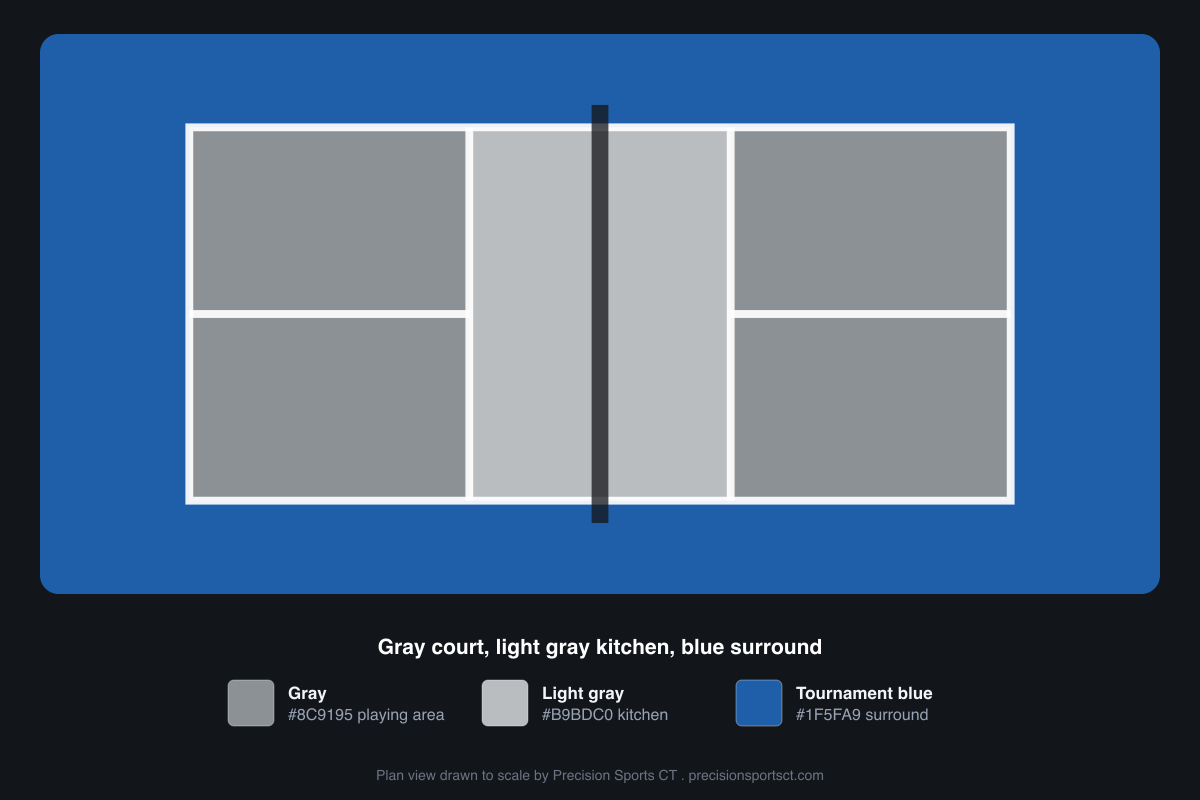
| Medium gray | Light gray | Blue | Modern look, low glare, indoor courts | Reads as industrial to some owners | |
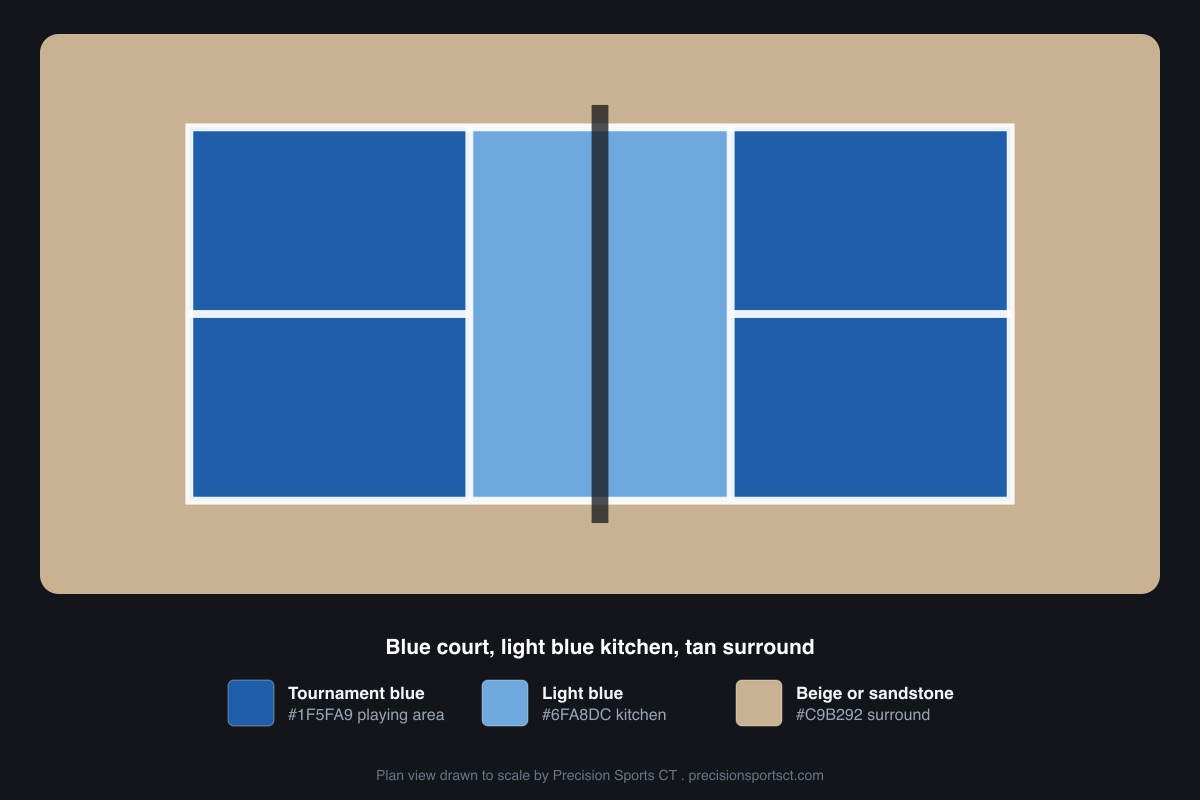
| Blue | Light blue | Tan or beige | Hot climates such as Florida | Tan shows tire and shoe marks | |
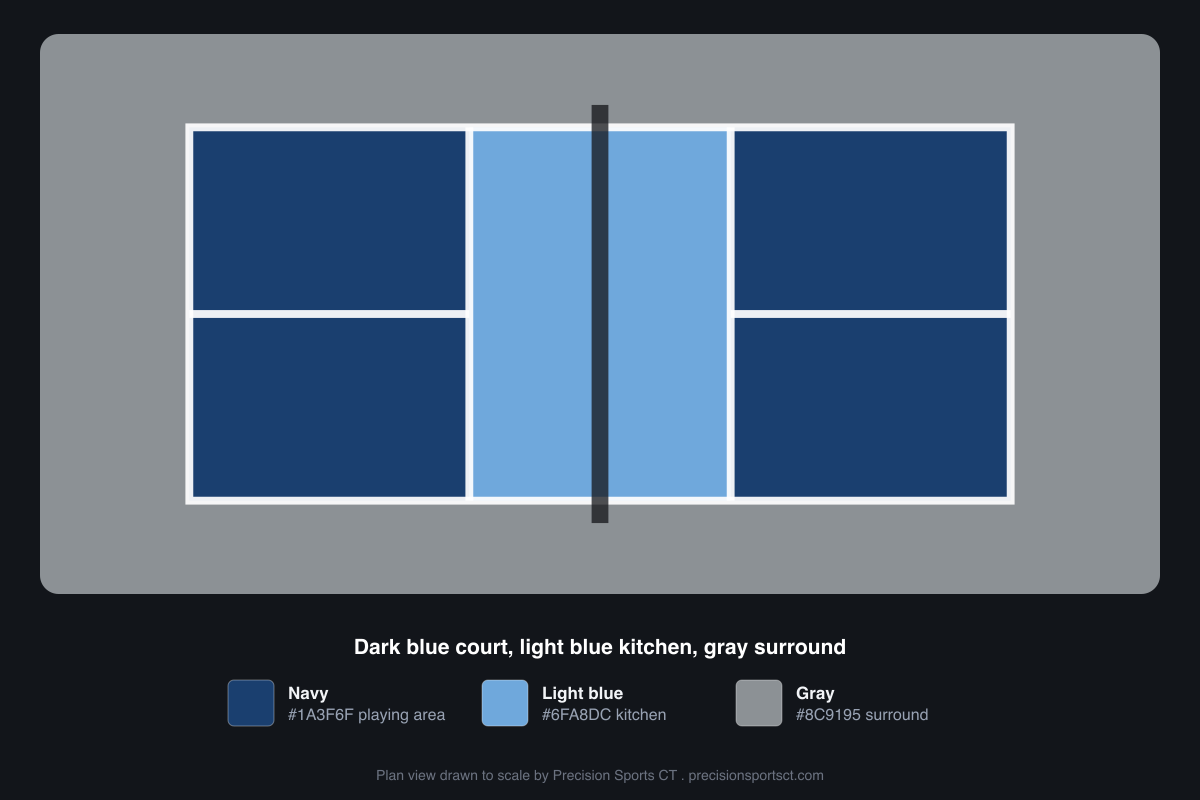
| Dark blue | Light blue | Gray | Clubs wanting a high-contrast, low-glare court | Dark blue absorbs the most heat |
Each scheme in the first column is drawn in plan view: the outer band is the out-of-bounds surround, the inner rectangle is the playing area, the band across the middle is the non-volley zone on both sides of the net, and the white line marks the net itself. Colors are approximate screen equivalents, not manufacturer specifications.
Every Pickleball Court Color Scheme in Plan View
Each pickleball court color scheme below is drawn to scale as a full court: a 44 by 20 foot playing area on a 60 by 30 foot paved pad, with the 7 foot non-volley kitchen on both sides of the net and the service courts in place. Save or share any of them when you brief a builder, and read the hex codes as planning approximations rather than coating specifications.
Pickleball Courts Have Three Color Zones, Not Two
This is the single biggest difference between choosing pickleball court colors and choosing tennis court colors. A tennis court is normally a two-color decision: playing area and surround. A pickleball court is usually three.
| Zone | Size | What the color does |
|---|---|---|
| Playing area | 20 ft by 44 ft inside the lines | Carries ball contrast; the color players actually track against |
| Non-volley zone (kitchen) | 7 ft from the net on each side, full 20 ft width | Marks the zone players cannot volley from; needs to read instantly in peripheral vision |
| Out-of-bounds surround | Everything out to the fence, commonly 30 ft by 60 ft total | The largest painted area, so it drives heat, glare, and how dirty the court looks |
The kitchen is the zone that trips people up. Painting it a completely unrelated color, for example a red kitchen inside a blue court, creates a hard visual edge that competes with the ball for attention. The approach that works is a lighter or darker shade of the playing area color: light blue inside blue, light green inside dark green. Players get an unmistakable zone boundary in peripheral vision without a color that pulls the eye off the ball.
For the full layout those zones sit on, see the pickleball court dimensions and layout guide.
Line Color and Width: What the Rules Require
USA Pickleball, the sport’s national governing body, specifies that court lines are 2 inches wide and painted in a single color that clearly contrasts with the playing surface. That is the entire requirement. There is no mandated line color.
In practice:
- White is the default on blue, green, and gray courts, and it is what tournament courts use.
- Yellow or black lines appear on light-colored or tan surfaces where white would not contrast enough.
- A distinct third color is used when pickleball shares a court with tennis or basketball, so the two layouts can be told apart at a glance. On a shared basketball court the surface color is usually decided by the basketball scheme first, and our guide to choosing colors for a basketball court explains why that decision constrains every line color added afterward.
The contrast requirement is a playability rule, not a cosmetic one. A line that blends into the surface produces disputed calls, and the non-volley line in particular has to be readable while a player is moving forward at full speed.
Match the Court Color to the Ball Color
Tennis has one ball color. Pickleball does not, and this is where generic color advice falls down. USA Pickleball approved balls are sold in optic yellow, neon green, orange, and white, and each one behaves differently against a given surface.
| Ball color | Reads best on | Reads worst on |
|---|---|---|
| Optic yellow | Blue, dark green, gray | Light green, tan |
| Neon green | Blue, gray, dark blue | Green of any shade |
| Orange | Blue, gray, green | Tan, red, terracotta |
| White | Blue, dark green, gray | Light gray, tan, concrete |
If your club, school, or facility standardizes on one ball, choose the court color for that ball. The most common expensive mistake we see is a light green court paired with neon green balls, which is the worst pairing in the table above and cannot be fixed without resurfacing.
Indoor Versus Outdoor Pickleball Court Colors
Indoor courts are lit by fixed artificial light rather than a moving sun, which changes two things:
- Glare comes from the coating sheen, not the sky. Indoor courts benefit from matte or low-sheen acrylic finishes; a glossy surface under direct downlighting produces hotspots exactly where players are looking.
- Contrast has to work harder. Artificial light is flatter than daylight, so mid-tone colors lose separation. Blue and medium gray hold contrast under indoor lighting better than light green does.
Outdoor courts have the opposite problem: sun angle, seasonal glare, and heat. That is why court orientation and color get planned together rather than separately.
What We Used on the PPA National Championship Courts
Precision Sports CT resurfaced and finished the courts for the Professional Pickleball Association National Championship in Dallas, Texas in 2025, covering both indoor and outdoor playing environments. The controlling requirement on that project was not which colors looked best in isolation. It was visual uniformity across every court in the venue, so that a player moving from court 3 to court 11, or from an indoor court to an outdoor one, saw the same contrast relationship between ball, playing area, kitchen, and surround.
Two things carried over from that build into how we specify color on club and residential courts:
- Batch consistency matters more than the swatch. Acrylic color coatings are mixed products. Courts finished from different batches can read as visibly different colors side by side in daylight even when the specification is identical. Multi-court projects need the coating quantity calculated and ordered as one lot.
- Indoor and outdoor courts at the same facility need different specifications to look the same. Matching an outdoor court’s appearance indoors usually means adjusting the sheen, not the color.
You can see the project detail on the PPA National Championship build.
Color on Tennis Courts Converted to Pickleball
Converted courts are the hardest color problem in the sport, because the surface has to serve two line layouts at once. There are two honest options:
- Blended lines. The pickleball lines go down in a color close to the court surface, so they are visible for pickleball play but recede during tennis. This is the standard compromise for courts that still host real tennis.
- Dedicated repaint. The tennis lines come out entirely at resurfacing and the surface is repainted as a dedicated pickleball layout, usually two to four courts inside the old tennis footprint. Contrast is then unrestricted, and the court can use a normal three-zone scheme.
The choice is a usage question rather than an aesthetic one: if tennis is still played on the court more than occasionally, blended lines are the answer. Full detail on both paths is in the tennis to pickleball conversion guide.
Heat, Glare, and How Long Color Lasts
Dark acrylic coatings absorb more solar energy and run warmer than light ones. On a pickleball court the effect is amplified because the surround is the largest painted area, so a dark surround radiates heat across the whole enclosure. In hot climates, including our Florida work, the usual answer is a darker playing area for ball contrast paired with a lighter surround for heat.
Color life is a maintenance question. Acrylic color coats typically hold their appearance for 4 to 8 years before fade, chalking, and traffic wear justify a re-coat, with full-sun and high-volume courts at the short end. Because new coatings and fresh lines are applied together, resurfacing is the natural moment to change a color scheme rather than a reason to avoid one. See pickleball court resurfacing in Connecticut for the process and timing, and the pickleball court cost guide for what surfacing work costs.
The American Sports Builders Association, of which Precision Sports CT is a member, treats color coating as a performance layer rather than paint: the acrylic system carries the court’s texture and speed as well as its color, which is why coating choice and color choice are made at the same time.
FAQs About Pickleball Court Colors
Q: What are the best pickleball court colors? A: The most common scheme is a blue playing area with a green surround and a lighter blue non-volley zone. Blue gives yellow and neon green balls the strongest contrast, and the green surround hides dirt across the largest painted area.
Q: What color should the pickleball kitchen be? A: A lighter or darker shade of the playing area color rather than a different hue. Light blue inside blue, or light green inside dark green, marks the zone clearly without competing with the ball for the player’s attention.
Q: What color are pickleball court lines? A: USA Pickleball requires lines 2 inches wide in a single color that clearly contrasts with the surface. White is standard on blue, green, and gray courts. Shared tennis or basketball courts use a distinct color for the pickleball layout.
Q: Does court color affect ball visibility? A: Yes. Approved balls come in optic yellow, neon green, orange, and white, and each reads differently by surface. Neon green balls on a light green court is the weakest common pairing; yellow or neon green on blue or gray is the strongest.
Q: Can a pickleball court be any color? A: Practically, yes, as long as the lines still clearly contrast with the surface. In practice the palette is limited by what acrylic color coating systems are manufactured in, which is why blue, green, gray, tan, and red dominate.
Q: Should indoor pickleball courts use different colors? A: The colors can be the same, but the finish should not be. Indoor courts under fixed downlighting need a lower sheen to avoid glare hotspots, and they hold contrast better with blue or medium gray than with light green.
Choosing a Scheme With Your Court Builder
Color is decided at the same time as the coating system, the texture, and the line layout, which means it belongs in the specification conversation rather than at the end of the project. A builder should be able to tell you what ball your players use, whether the court is shared with another sport, how much sun the site takes, and how many courts have to match each other, before recommending a scheme.
Precision Sports CT builds and resurfaces pickleball courts across Connecticut and Florida, from backyard courts to the PPA National Championship. If you are planning a new court or a re-coat, get in touch for a quote and we will walk through the color and coating options for your site.